How to Choose the Best Brain Supplement Without Caffeine
Quick Answer: How Do You Spot a Genuinely Caffeine-Free Formula?
Ignore the front of the bottle and read the botanical names in the ingredient panel. Any product listing Camellia sinensis, Paullinia cupana, Cola nitida, Ilex paraguariensis, Coffea arabica or whole coffee fruit contains caffeine unless the label states the extract is decaffeinated. A genuinely caffeine-free formula names every ingredient with its amount, carries none of those plants, and does not hide behind a proprietary blend.
- Biggest trap: "stimulant-free" is marketing language, not a regulated claim.
- Fastest check: scan the Latin names, not the marketing copy.
- Deal-breaker: a proprietary blend that hides individual amounts.
Why "stimulant-free" and "caffeine-free" are not the same claim
There is no regulatory definition of "stimulant-free" on a dietary supplement. Nothing stops a brand from putting it on the carton while a caffeine-bearing plant extract sits three lines down the ingredient list. In practice the phrase is often used to mean "we did not add synthetic caffeine anhydrous", which is a much narrower promise than the one most shoppers hear.
That gap matters because the people searching for the best brain supplement without caffeine usually have a specific reason. They get palpitations. They are managing anxiety and caffeine sharpens it. They take a formula at 2pm and lie awake at 11pm. They are pregnant, or on blood pressure medication, or simply tired of a tolerance cycle where a scoop that worked in January does nothing by March. For all of those readers, "we didn't add powdered caffeine" is not the answer to the question they asked.
The second reason to be sceptical is dose opacity. Where caffeine comes from a standardised plant extract, the amount delivered depends on the extract ratio and the standardisation, neither of which many labels disclose. A product can therefore be honest about its ingredients and still leave you unable to work out whether you are getting five milligrams of caffeine or eighty.
The hidden caffeine sources that appear on "stim-free" labels
Caffeine occurs naturally in more than sixty plant species, and a handful of them are standard supplement ingredients. Learning six Latin names does more for you than any front-of-pack claim.
Green tea extract (Camellia sinensis). The single most common one. Green tea leaf is roughly two to four per cent caffeine by weight, and extracts concentrate it further. Decaffeinated green tea extracts exist and are used specifically so a formula can carry the catechin EGCG without the stimulant, but the label has to say "decaffeinated" for you to assume it. Matcha, white tea, oolong and black tea extract are all the same plant.
Guarana (Paullinia cupana). Guarana seed is unusually caffeine-dense, typically well above the caffeine content of a coffee bean by weight. It also releases more slowly, which is why energy products like it and why an afternoon dose can still be with you at bedtime.
Kola nut (Cola acuminata, Cola nitida). A traditional West African stimulant, and the historic source of the "cola" in soft drinks. It carries a meaningful percentage of caffeine and appears in "natural energy" blends.
Yerba mate (Ilex paraguariensis). Lower in caffeine than guarana but far from free of it, and often described in copy as an "herbal" or "gentle" ingredient in a way that implies otherwise.
Coffee fruit and coffeeberry (Coffea arabica). Whole coffee fruit extract is marketed for its polyphenols rather than its caffeine, and some suppliers decaffeinate it. Many do not.
Cocoa (Theobroma cacao). Cocoa extract carries a small amount of caffeine plus a larger amount of theobromine, a chemical cousin with a milder, longer-lasting stimulant effect. If you react badly to caffeine, theobromine is worth knowing about too.
Caffeine-bearing ingredients at a glance
| Ingredient on the label | Latin name | Typical caffeine content of the raw plant | What to watch for |
|---|---|---|---|
| Green tea / matcha extract | Camellia sinensis | Roughly 2–4% of leaf weight; extracts vary widely | Only safe if the label says decaffeinated |
| Guarana seed extract | Paullinia cupana | Higher than coffee bean by weight | Slow release; lingers into the evening |
| Kola nut extract | Cola acuminata / nitida | Around 1–3.5% of nut weight | Often framed as "traditional", not as a stimulant |
| Yerba mate | Ilex paraguariensis | Roughly 1–2% of leaf weight | Marketed as a herbal tea ingredient |
| Coffee fruit / coffeeberry | Coffea arabica | Present unless specifically removed | Sold for polyphenols; caffeine comes along |
| Cocoa extract | Theobroma cacao | Small caffeine content plus theobromine | Theobromine is a milder, longer-acting relative |
| Theacrine, methylliberine | — | Not caffeine, but stimulant-like | Technically caffeine-free, not effect-free |
Two entries in that table deserve a note. Theacrine and methylliberine are genuinely not caffeine, so a product containing them can truthfully print "caffeine-free" while still being a stimulant. And the caffeine percentages above describe the raw plant material, not the finished extract, which is exactly why an undisclosed extract ratio makes a label unreadable.
Prefer a formula with no stimulant botanicals at all?
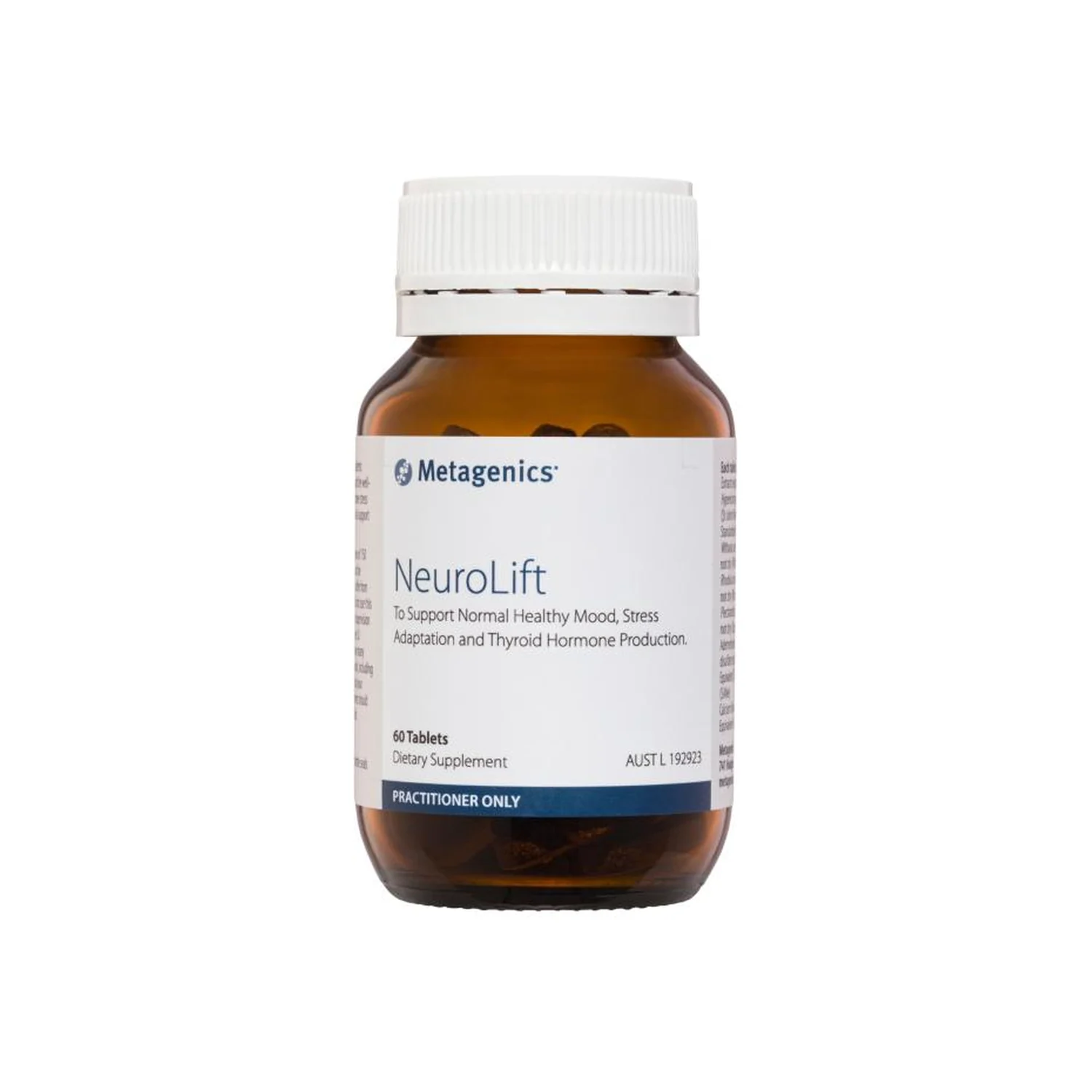
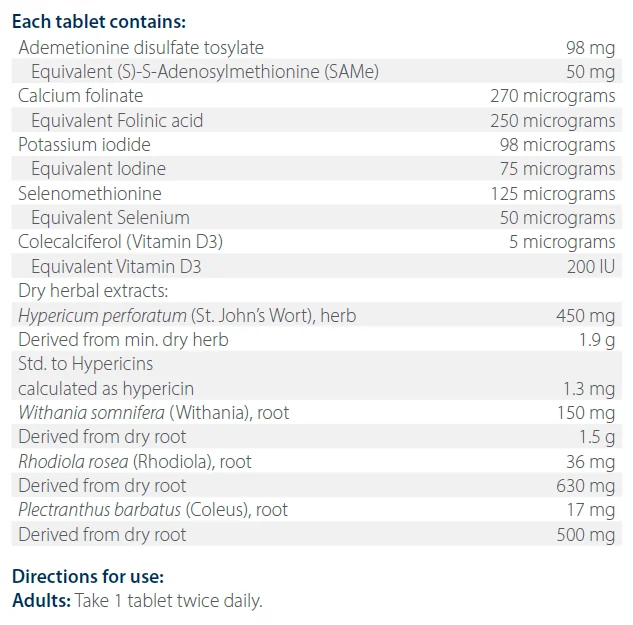
Neuro Lift is a twice-daily tablet built around SAMe, folinic acid, iodine, selenium and four botanicals — none of which is a caffeine source. If you have been comparing where to buy brain supplements that leave the stimulants out, start with the full ingredient panel.
Check Availability & PricingWhat the best brain supplement without caffeine looks like on paper
Strip away the marketing and a defensible caffeine-free label has five properties. First, every active is named with its own amount in milligrams or micrograms, so you can compare it against the amounts used in published human work. Second, botanical ingredients carry their Latin name, the plant part used and the standardisation, because "ginkgo 100 mg" tells you almost nothing while "Ginkgo biloba leaf extract, standardised to 24% flavone glycosides" tells you a great deal.
Third, there is no proprietary blend. A blend is a legal way to declare a total weight without telling you the split, and it is used far more often to conceal a thin dose than to protect a formula. Fourth, the serving size is realistic for the format: a single small capsule cannot physically hold gram-scale doses, so a label promising eight ingredients "at clinical strength" in one 500 mg capsule is arithmetically impossible. Fifth, the allergen and excipient lines are complete, because that is where a caffeine-bearing flavouring occasionally hides in powders and gummies.
Anyone shopping for the best brain health supplement on that basis will find the field thins out quickly. That is the point. The label is the only part of a supplement you can verify before you own it.
The front of a supplement box is written by a marketing team. The ingredient panel is written by a regulatory team. Only one of them is legally accountable for being accurate, and it is not the one with the lightning bolt on it.
Caffeine-free ingredients that actually have human evidence
Removing caffeine only helps if what replaces it does something. Honest grading of the non-stimulant options looks roughly like this.
Correcting a real shortfall is the strongest play. Iodine and selenium are required for normal thyroid hormone production, and thyroid hormone sets a great deal of your baseline mental pace. Vitamin B12, vitamin D and iron each have well-documented links to fatigue and poor concentration when you are low. Sorting which vitamins for memory and focus genuinely help from the ones sold on suggestion is the first job here. None of these does anything noticeable if your levels are already fine, which is the honest caveat nobody prints on a carton.
Citicoline and alpha-GPC supply choline, the raw material for acetylcholine. Short human trials in healthy adults have reported modest attention benefits with citicoline, and the choline chemistry is well understood, though the studies are small and mostly brief. We go through the forms and the doses in our guide to alpha-GPC and choline sources.
L-theanine is an amino acid from tea that is usually paired with caffeine to smooth it out, but it has been studied on its own for relaxed alertness. It is a genuinely non-stimulant option, and one of the few ingredients whose subjective effect most people notice within an hour.
Creatine monohydrate is the most under-rated caffeine-free option. Its cognitive effects appear largest under sleep deprivation or in people eating little meat, which describes a lot of the audience for these products.
Adaptogens such as Withania somnifera and Rhodiola rosea target stress rather than stimulation, and we weigh that trial record against the mood herbs in our review of St John’s Wort and ashwagandha for mood and stress. The trials are small and short, so the fair summary is encouraging rather than settled, and the effect builds over weeks instead of arriving in an hour — a pace we map ingredient by ingredient in how long nootropics take to work.
Ginkgo and bacopa both have long research histories and genuinely mixed results. Bacopa's memory findings usually need eight to twelve weeks of daily use; ginkgo's large prevention trials in older adults were disappointing. Neither belongs in the "proven" column, and any page that tells you otherwise is selling something.
Decaffeinated, naturally sourced and other slippery words
"Decaffeinated" means most of the caffeine has been removed, not all of it, and the residual amount is rarely disclosed. For someone genuinely sensitive, a decaffeinated green tea extract at a modest dose is usually a non-issue; for someone avoiding caffeine on medical advice, ask the manufacturer for the specification sheet rather than guessing.
"Natural caffeine" is a sourcing statement, not a pharmacological one. Caffeine from guarana and caffeine from a laboratory are the same molecule and behave the same way in your body; the plant simply arrives with other compounds attached. "Sustained-release" and "buffered" caffeine change the curve, not the total.
"Nootropic" itself is unregulated. It means whatever the person printing the box wants it to mean, and it appears equally on formulas with a decade of published work behind them and on flavoured caffeine with a hologram sticker.
A sixty-second panel check you can do in the aisle
Turn the box over and work down the panel in this order. Scan the botanical column first for the six Latin names above and put the product back if any appear without "decaffeinated" beside them. Then look for the words "proprietary blend" and treat them as a stop sign. Then check that the serving size matches the amounts claimed, because two capsules of 500 mg cannot deliver 1,800 mg of actives. Then look at the standardisation on each herb. Finally check the "other ingredients" line for tea or cocoa hiding as a flavour.
If you are comparing the best brain supplement for memory and focus across several brands, do that check on all of them before you read a single marketing paragraph. It ranks products faster than any amount of promotional copy, and it is the same procedure a formulator would use.
What a caffeine-free formula cannot do
This is the part most pages skip. Removing caffeine removes the one ingredient in the category whose acute effect is reliable and obvious. A non-stimulant formula will not give you the fifteen-minute lift that a strong coffee gives you, and if that is what you are shopping for, you will be disappointed no matter how good the label looks.
Nor can any of these products substitute for sleep. Every ingredient discussed here has been studied against a background of normal rest, and none of them has been shown to compensate for chronic short sleep. The same ordering holds for younger household members, where sleep, breakfast and screen timing outrank any product. The same goes for untreated anxiety, low thyroid function, iron deficiency, depression or an attention disorder: these are medical matters that need a clinician and a blood test, not a supplement bought on a search result. Nothing on this page treats, prevents or reverses any condition.
Two more honest limits. Finished multi-ingredient products are almost never trialled as finished products, so evidence for the ingredients is not evidence for the blend. And the amount in a capsule is frequently below the amount used in the studies being cited for it, which is exactly why the itemised panel matters more than the citation list.
Medical note: this article is general information, not medical advice. Some botanical ingredients, St John's Wort in particular, interact with prescription medicines including the contraceptive pill and antidepressants. Speak to a doctor or pharmacist before starting any supplement, and especially if you are pregnant, nursing, taking medication or managing a health condition.
Scientific references
- Harvard T.H. Chan School of Public Health, The Nutrition Source — Caffeine
- Mayo Clinic — Caffeine: How much is too much?
- NIH NCCIH — Green Tea (Camellia sinensis)
- NIH Office of Dietary Supplements — caffeine in dietary supplements
- Kahathuduwa C.N. et al. (2018) — l-Theanine and caffeine improve target-specific attention to visual stimuli by decreasing mind wandering, Nutrition Research
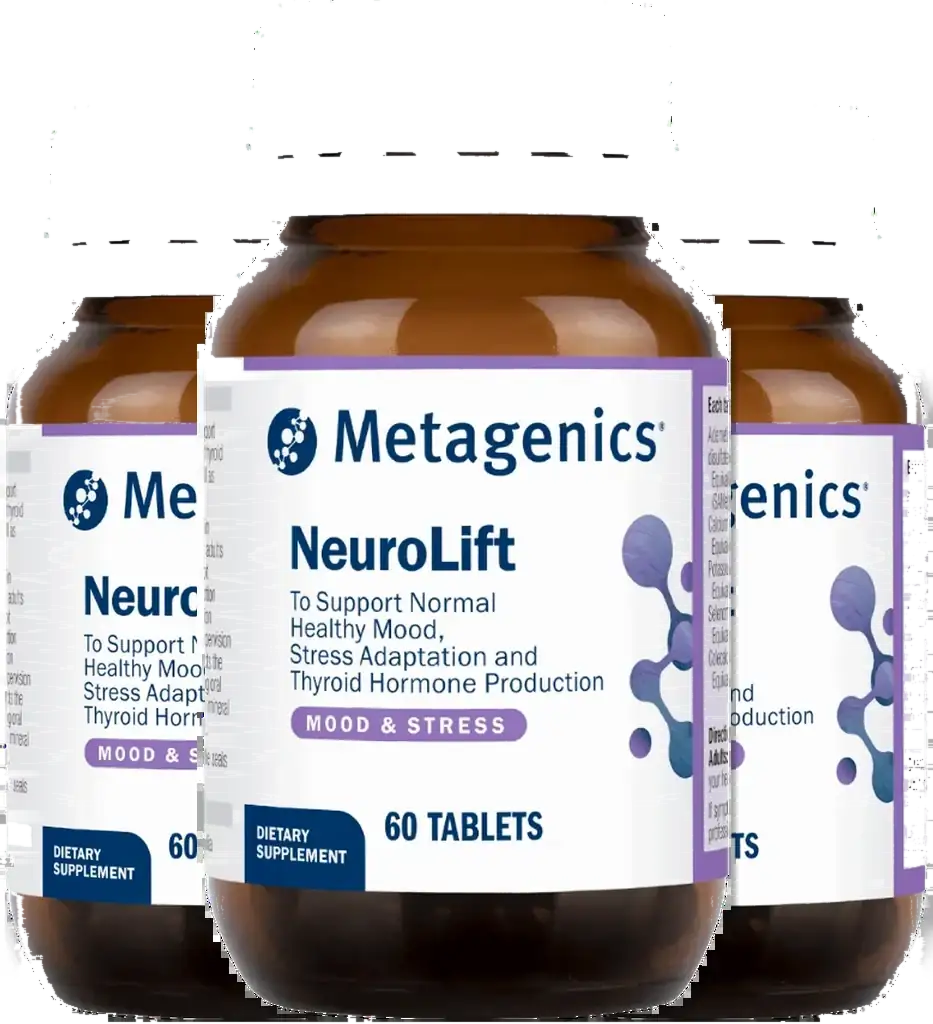
A daily formula with no stimulants in it
SAMe, folinic acid, iodine, selenium, vitamin D3 and four botanicals in a twice-daily tablet — every ingredient itemised, no proprietary blend, no caffeine source. See the current Neuro Lift ingredient breakdown before you decide.
See Availability on the Official Store